Class 1: Introduction to GraphQL
Learn what GraphQL is, why to use it, and how it differs from REST.
Duration: ~10 minutes | Difficulty: Beginner | Prerequisites: None
What is GraphQL?
GraphQL is an open-source query language for APIs and a server runtime for fulfilling those queries.
REST often makes you call several endpoints to gather related data, which is under-fetching, or return large JSON documents full of fields you never use, which is over-fetching. GraphQL fetches exactly the data you need, in a single request.
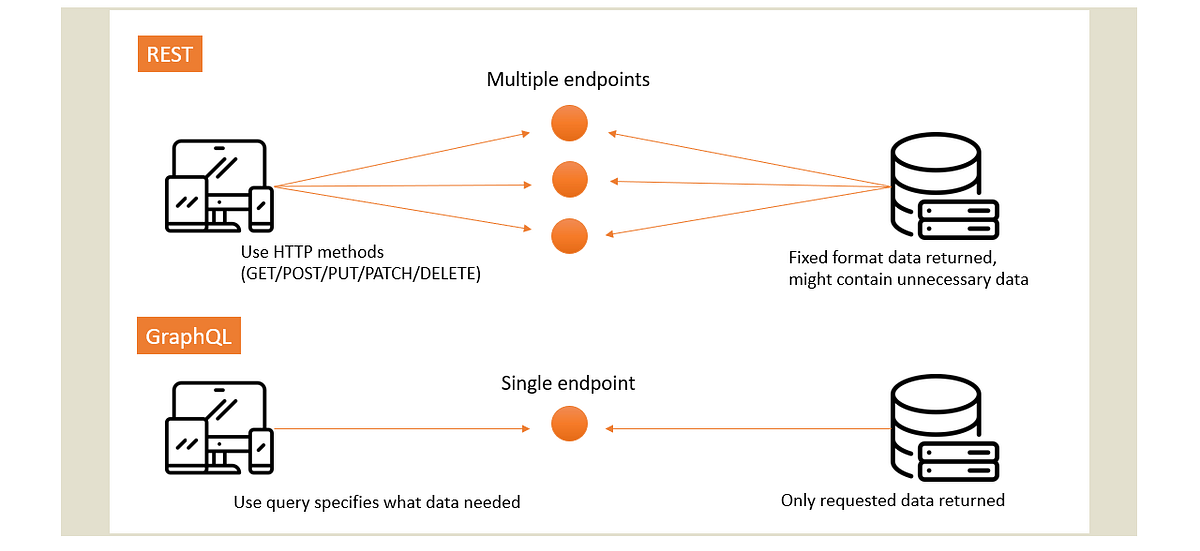
- Query language for APIs (not databases)
- Single endpoint for all operations
- Client specifies exactly what data it needs
- Server returns JSON matching the query shape
- Strongly typed schema as the contract
GraphQL isn't tied to any specific database or storage engine - it sits in front of your existing code and data.
The Core Idea
GraphQL comprises two parts:
- Query Language - specific language that enables the API client to specify their intent, such as what data to query, which action to perform...
- Server Runtime - executes above requests against a schema
Request Flow
We will talk a lot about this later, but as an overview, the usual flow goes something like:
GraphQL vs REST
As most developers are already familiar with REST APIs, I find it easiest to explain GraphQL just by drawing a parallel with a similar REST API.
The Scenario
Let's imagine we want to build a website showing some info about movies. We want to display a page that lists the movie title, its release year, some reviews, and the awards it has received or been nominated for.
REST Approach
With REST, we typically need multiple requests:
- Multiple round-trips to the server
- Over-fetching - response includes unused fields
- Under-fetching - need separate endpoints for related data
GET /movies
[
  {
    "id": 1,
    "title": "Star Wars: Episode IV",
    "genre": "Adventure Epic",
    "releaseYear": 1977,
    "durationMinutes": 121,
    "originalTitle": "Star Wars",
    "summary": "Luke Skywalker joins forces with a Jedi Knight..."
  }
]

GET /movies/reviews?movieIds=1
[
  {
    "id": 111,
    "movieId": 1,
    "rating": 9.5,
    "title": "Visually stunning sci-fi",
    "comment": "The story starts slow but really pays off.",
    "userId": 42,
    "createdAt": "2024-06-12T14:23:00Z"
  }
]

GET /movies/awards?movieIds=1
[
  {
    "id": 111,
    "movieId": 1,
    "name": "Oscar",
    "category": "Best Picture",
    "status": "NOMINATED"
  }
]
GraphQL Approach
With GraphQL, one request gets exactly what we need:
- Single round trip
- No over-fetching - only requested fields returned
- Client controls the exact shape of the response
Query:
query MoviesWithReviewsAndAwards {
  movies {
    title
    releaseYear
    reviews {
      rating
    }
    awards {
      name
      category
    }
  }
}
Response:
{
  "data": {
    "movies": [
      {
        "title": "Star Wars: Episode IV",
        "releaseYear": 1977,
        "reviews": [
          { "rating": 9.5 },
          { "rating": 9.8 }
        ],
        "awards": [
          { "name": "Oscar", "category": "Best Picture" }
        ]
      }
    ]
  }
}
Notice that the response shape mirrors the query shape exactly.
Key Differences
| Aspect | REST | GraphQL |
|---|---|---|
| Endpoints | Multiple (one per resource) | Single (/graphql) |
| Data shape | Server decides | Client decides |
| Fetching | Often over/under-fetches | Precise fetching |
| Versioning | URL versioning (/v1/, /v2/) | Schema evolution |
| Documentation | External (OpenAPI, etc.) | Built-in (introspection) |
The Schema (The Contract)
A GraphQL service is created by defining types and their fields in a Schema, and we'll go through it in detail in a dedicated class. Still, for now, this is how a Schema might look for the example service we defined above.
type Movie {
  id: ID!
  title: String!
  releaseYear: Int!
  reviews: [Review!]!
  awards: [Award!]!
}

type Review {
  id: ID!
  rating: Float!
  comment: String
}

type Award {
  id: ID!
  name: String!
  category: String!
  status: AwardStatus!
}

enum AwardStatus {
  NOMINATED
  WON
}

type Query {
  movies: [Movie!]!
  movie(id: ID!): Movie
}
Don't worry if this looks unfamiliar to you - we'll explore schemas in depth in the next class.
When to Use GraphQL
GraphQL excels when:
- Multiple clients need different data shapes (web, mobile, etc.)
- Complex UIs require data from multiple sources
- Rapid iteration demands flexible APIs
- Network efficiency matters (mobile, slow connections)
GraphQL may not be the best fit when:
- Simple CRUD with a few clients
- File uploads are the primary use case (GraphQL as a specification doesn't support file upload)
- Caching at the HTTP level (CDN) is critical
Summary
| Concept | Description |
|---|---|
| GraphQL | Query language for APIs with a server runtime |
| Single endpoint | All operations go through one URL |
| Client-driven | Clients specify exactly what they need |
| Schema | Typed contract defining the API |
| Response shape | Mirrors the query structure |
What's Next?
In the next class, we'll explore Class 2: A Brief History of GraphQL - how it was created at Facebook and evolved into a mainstream API technology.